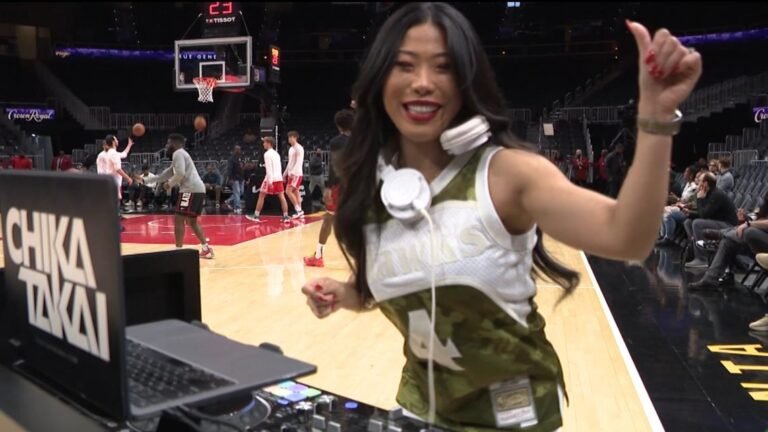
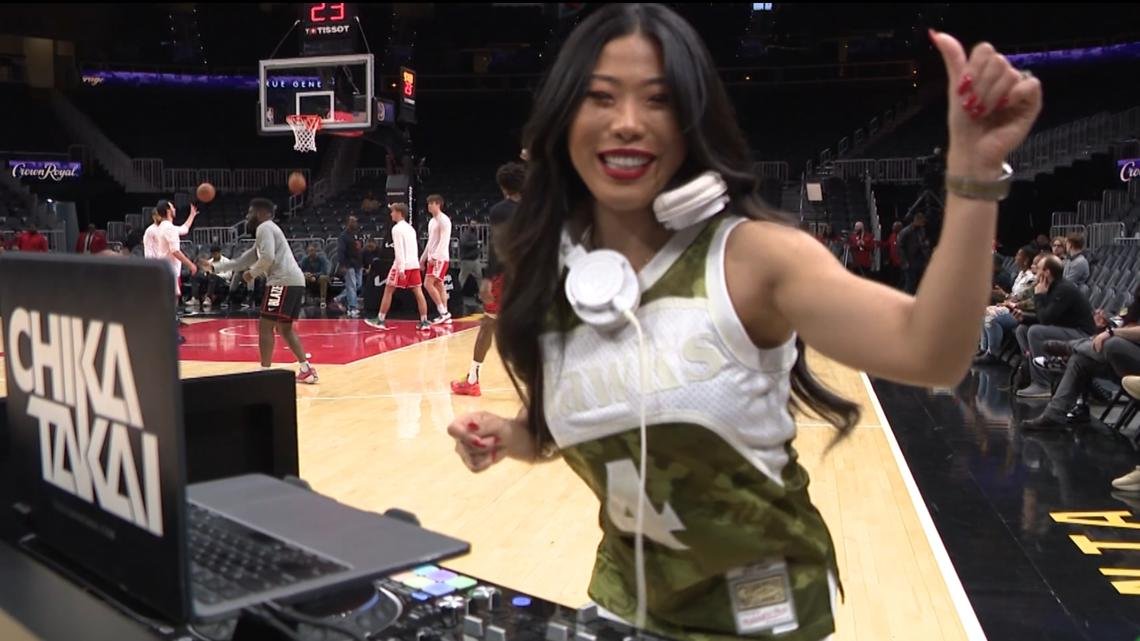
The first Japanese female resident DJ for the Atlanta Hawks performs during an NBA game. Courtesy of Chika Takai
Building a Path Without a Blueprint
Leading With Feeling, Not Explanation
Representation as Presence, Not Pressure
Turning Identity Into Impact
Question and Answer Interview with Chika Takai
1. You achieved all of this just a few years after arriving in the U.S. without speaking English—what moments early on almost made you quit, and what kept you going anyway?
There were more moments than I’d like to admit. One of the earliest was when I made the dance team and realized I couldn’t fully communicate with my teammates. Performances would be amazing, but off the court I felt a half a step behind, missing jokes and cues. It was quite an adjustment to feel so visible onstage and so invisible in conversation.
Outside of work, the challenges were just as real. Not understanding the language well enough to figure out how to get a car, a driver’s license, or insurance made everyday life feel a little overwhelming. Simple tasks carried so much anxiety, and there were days when it felt like the world was moving faster than I could catch up to.
What kept me going was kindness. Teammates who were patient, who showed up for me without needing an explanation, and who made space for me even when communication was hard. And through all of it, my then-boyfriend—now my husband—was right by my side, steady and supportive when I felt unsteady myself. Their compassion reminded me that I didn’t have to have everything figured out to belong, and that belief gave me the strength to keep moving forward.
2. Being the first often means building the path while walking it. What did no one prepare you for when you stepped into these NBA spaces?
No one prepared me for how competitive the environment was—or how invisible the competition could be. In NBA spaces, excellence is assumed and you’re constantly measured against an unspoken standard that was built long before you arrived. There’s no onboarding for that. You learn quickly that you have to be sharp every single time, because there’s rarely room for error when you don’t fit the familiar mold.
What also surprised me was how few Asian women were in roles on the entertainment side. There weren’t many reference points, mentors, or examples of what longevity could look like. That meant figuring things out in real time—how to ask questions without slowing down the train, and how to trust my instincts even when I was the only one in the room with my perspective.
But that gap became a kind of clarity. Without a script to follow, I had to build my own rhythm, my own style, my own definition of success. And in doing that, I realized the path wasn’t just something I was walking—it was something I was actively shaping for whoever comes next.
3. How did you translate who you are culturally and artistically into environments that had never seen—or heard—someone like you before?
I didn’t try to translate myself by simplifying or explaining—I led with feeling. Culture and artistry land most powerfully when they’re experienced, not labeled. So instead of asking whether a space was “ready” for me, anytime I was front and center on stage, I focused on being fully present without a filter. I wanted people to meet the work before they met the story. I knew that once trust was built and they saw I not only respected the environment but could also comfortably navigate within, the layers revealed themselves organically.
I’ve learned that when you’re rooted in who you are, unfamiliarity turns into curiosity, and curiosity turns into connection. That’s how something new stops feeling foreign and starts feeling necessary.
4. When you became the first Japanese and the first female resident DJ for the Atlanta Hawks, did the weight of representation feel empowering, heavy, or both?
It felt empowering—fully and intentionally so. I don’t experience it as a weight I have to carry, but as a door that’s already open, with light pouring through it.
Representation, in that moment, wasn’t about pressure or proving anything; it was about presence. Just showing up as myself was enough. I wasn’t thinking about being “the first” while I was doing the work. I was thinking about connection, joy, and being the very best I could be. The meaning comes after, when you realize someone else might see themselves a little more clearly because you were there. That’s not heavy—that’s affirming. It reminds me that being visible, grounded, and joyful in my craft can be its own form of representation.
5. Music, dance, and hosting all live at the intersection of performance and identity. How do you decide when to blend in and when to stand out?
I try to listen to the room first—what the moment is asking for—before I listen to my ego. Blending in, for me, is about respect: honoring the space, the culture, and the people who came before me. It’s knowing when my job is to support the energy rather than redirect it. Standing out comes from the opposite place, but the same intention. When I do step forward, it’s because there’s something honest I can offer that would be missing if I stayed quiet.
I don’t aim to be different just to be visible and If I am fully myself, the distinction happens naturally. So the decision isn’t really strategic—it’s ethical. I ask: Is this about the audience or about attention? When it’s about the audience, blending in can be powerful. When it’s truth, standing out becomes necessary.
6. You’ve made history in roles traditionally dominated by men and by Americans. What did you have to unlearn in order to fully claim your space?
I didn’t have to unlearn anything. Instead, I used everything I had learned up to that point. My culture, my training, my instincts, my perspective—they were never obstacles to overcome, they were tools. Rather than trying to fit into an existing mold, I let those experiences inform how I showed up and did the work.
Claiming my space wasn’t about shedding parts of myself to be more acceptable. It was about trusting that what I already carried was enough to create a new lane. By honoring where I came from and how I learned, I wasn’t asking for permission—I was building something that hadn’t existed before, in a way that only I could.
7. What was the emotional difference between your first NBA All-Star selection and being selected a second time for a different role?
The first time was pure jubilation wrapped in disbelief. It felt like being lifted into a moment I had only ever imagined, suddenly made real. There was so much honor in it, but also real nervousness—standing on a stage that big, knowing how rare the opportunity was. What made it even more emotional was the contrast: just a short while before, I couldn’t even speak the language. I was in another country, dreaming about coming to America, and suddenly I was here, selected for NBA All-Star. The anticipation wasn’t just about the event—it was about realizing how far the journey had already carried me.
The second time brought that same honor and excitement, but with a deeper sense of awareness. The disbelief was quieter, replaced by reflection. I knew what it took to get there, and that made the anticipation feel intentional rather than overwhelming. The nerves were still there, but they came with gratitude and confidence. Being chosen again, in a different role, felt like the journey speaking back to me—acknowledging not just the dream, but the growth that happened between imagining it and living it.
8. Whether as a Captain of an NBA Dance Team or the official DJ, how has leadership meant something different for you than simply being the best performer in the room?
Leadership, for me, has always been about lifting others up, not just standing out myself. Being the best performer in the room can earn attention, but leadership is about creating an environment where everyone can shine.
As a Captain or as an official DJ, it meant listening, observing, and understanding what the team or the audience needed—sometimes that meant stepping forward, other times it meant stepping back. To me leadership isn’t measured by applause or skill alone; it’s measured by the trust you build, the support you offer, and the culture you help foster.
9. How do you stay creatively authentic in a global entertainment industry that often pressures artists to fit a single narrative?
I stay creatively authentic by staying unapologetically me. The industry often tries to define what an artist should be, but I’ve learned that my voice, my perspective, and my energy are what make my work meaningful.
I focus on what feels true in the moment—whether it’s the music I play, the way I move, or the experiences I create—rather than bending to someone else’s expectations. Authenticity isn’t about fitting in; it’s about trusting myself, honoring my journey, and letting my individuality guide everything I do.
10. What did learning English while building a career in live sports entertainment teach you about communication beyond words?
Learning English while building a career in live sports entertainment taught me that words can change, but who I am as a human being doesn’t—and that matters more than fluency ever could. My values, my work ethic, my sensitivity to energy, and the way I show up for people were already intact long before I could express them in English.
It made me understand that communication is felt before it’s understood. Tone, timing, intention, presence—those things speak loudly, especially in live environments where emotion moves faster than language. I learned how much can be conveyed through listening, awareness, and respect, and how trust is built through consistency more than conversation. English gave me access, but my authenticity created connection—and that’s what truly carried me forward.
11. Was there a moment when you realized your success was bigger than you—that it was opening doors for others watching from afar?
I try not to look for those moments. If I start searching for them, I risk losing my authenticity and the organic way I create. What I do comes from being present.
That said, I can only hope my journey makes the road just a little bit easier for whoever is up next. If someone watching from afar feels a little less alone, or believes their path is possible because mine unfolded the way it did, that means everything. I don’t need to witness the impact directly to trust that it exists. Sometimes the most meaningful doors open quietly, and that’s enough for me.
12. How do Japanese values like discipline, respect, and perseverance show up in the way you approach NBA culture?
Japanese values shape everything I bring into NBA spaces. Discipline shows up in preparation—being ready, every time, for whatever the stage or the schedule demands. Respect guides how I engage with teammates, colleagues, and the culture itself: listening first, observing, and honoring the traditions already in place while finding my own place within them. Perseverance fuels the moments when I’m the only one in the room who looks or thinks like me—it’s the quiet drive to keep showing up, keep improving, and keep creating, no matter how steep the learning curve.
Together, these values help me navigate NBA culture not as an outsider trying to fit in, but as someone bringing my full self, thoughtfully, consistently, and intentionally.
13. In moments when you felt underestimated, what internal conversation helped you turn doubt into fuel?
In those moments, I often hear my father’s voice reminding me that I’m enough. Even when the world seemed to doubt me—or when I doubted myself—those conversations we had growing up came back: that my presence, my effort, and my perspective mattered just as they were.
That internal dialogue became fuel. It didn’t erase the challenges, but it gave me the confidence to keep moving, to keep showing up fully, and to trust that my work, my instincts, and my voice had value. It reminded me that external validation is temporary, but knowing your own worth carries you through anything.
14. What responsibility do you feel now toward young women, Asian creatives, and international artists who see themselves in your journey?
I feel a responsibility to leave breadcrumbs—to quietly mark the path of my journey so others can see where it’s possible to step. Not a blueprint, not instructions, but proof that the road exists and can be walked in many ways.
For young women, Asian creatives, and international artists, I hope those breadcrumbs say: you don’t have to erase yourself to arrive. You don’t have to wait for permission. If my path offers even a small sense of direction or reassurance, then I’m honoring the opportunities I was given. That feels less like pressure and more like gratitude—making sure the way forward is just a little more visible than it was for me.
15. When you look ahead, what does “next” mean for someone who has already redefined what’s possible at the intersection of sports, culture, and entertainment?
For me, “next” isn’t about chasing bigger stages or breaking more records—it’s about depth and impact. It’s about taking everything I’ve learned at the intersection of sports, culture, and entertainment and using it to create opportunities, build communities, and inspire the next generation.
It means expanding the conversation beyond performance by sharing knowledge and amplifying voices that haven’t been seen or heard. “Next” is less about personal milestones and more about leaving a legacy that makes the path a little clearer, a little more welcoming, and a little more vibrant for those who follow.
16. Off the court, what passions or interests help ground you when the spotlight and pressure of the NBA environment get intense?
Music is my elixir. It’s the place I return to when everything feels loud or heavy—the reset that brings me back to myself. Off the court, music reminds me why I started in the first place, before the lights, the pressure, or the expectations.
It grounds me because it’s honest and instinctual. Whether I’m listening, digging for new sounds, or simply letting a song carry the emotion of the day, it gives me clarity and calm. Music holds space for both release and reflection, and that balance is what keeps me centered when the NBA environment gets intense.
17. You’ve built a powerful personal brand alongside your creative career. What kinds of business ventures or projects excite you most outside of music and dance?
Well first off, I am also host and emcee, but what excites me most are projects that bring people together across cultures and create opportunities that didn’t exist before. That’s why I formed Experiential Global, a collective of diverse brands dedicated to collaboration, crafting unforgettable experiences, and supporting those seeking their place on the world stage.
Alongside that, I founded Global Experience, a nonprofit focused on creating professionally and culturally enriching experiences and networks for women globally. Having navigated the challenges of pursuing my own dreams abroad, I’m passionate about making that journey a little easier for the next generation of young girls who dream as I once did. Ventures that combine creativity, connection, and empowerment—where impact is as meaningful as innovation—are what truly light me up.
18. When you think about longevity, how intentional are you about turning your platform into something sustainable beyond performance?
Very intentional. I’m already doing that through my business and philanthropic ventures, creating structures that outlast any single performance.
Longevity, to me, isn’t just about career duration; it’s about impact that persists. Every step I take is with purpose, ensuring that the platform I’ve been given continues to inspire, uplift, and open doors long after the music stops or the lights dim.
19. Are there industries—fashion, media, wellness, tech, or culture—that you’re especially interested in exploring as an entrepreneur?
Absolutely. Whether through media or through experiences I curate, I’m deeply committed to spreading the culture surrounding basketball throughout Japan and Asia leaning into my degree in Asian Studies—building awareness, excitement, and opportunities that connect communities to the game through fashion, art, and music.
As an entrepreneur, I’m drawn to industries where culture and creativity intersect—spaces that allow me to highlight stories, inspire participation, and create experiences that go beyond the court. Fashion, media, and entertainment are natural extensions of that mission, because they give me tools to engage communities, celebrate identity, and build bridges between global audiences and the culture I love.
20. How has navigating the business side of entertainment in the U.S. challenged you differently than the creative side?
Navigating the business side of entertainment in the U.S. has challenged me in a way that’s very different from the creative side. Creativity is instinctual—I can feel it, shape it, and adjust it in real time. Business in the U.S. is very different than conducting business in Japan. Business here is extremely competitive, and you must be careful because every decision carries consequences beyond the studio or stage.
It has pushed me to develop skills I didn’t realize I needed: understanding contracts, building partnerships, protecting my brand, and thinking long-term while still honoring my artistic vision. The challenge is balancing structure with freedom—keeping the heart of my creativity alive while ensuring it’s sustainable, recognized, and respected in an industry that doesn’t always make room for voices like mine. It’s taught me that success isn’t just about talent—it’s about vision, resilience, and knowing how to advocate for yourself at every level.
21. If you weren’t performing in an NBA arena, what would a day in your ideal off-court life look like?
A day in my ideal off-court life would be filled with creating experiences that inspire and bring joy into people’s lives. I’d be collaborating with artists, curating moments that connect people across cultures, or exploring new ways to tell stories through music and movement. Sounds a lot like my normal workday but this is confirmation that I’m doing what is destined for me.
About the Author


[[Anthony L. McKnight II]] also known as Krispy was Born in Rochester, NY attending the “School Of The Arts” Class of 2009. He graduated with a Regents Arts diploma while studying Creative Writing and other arts. He recently became the founder of the Los Angeles Lakers Fan Club on Clubhouse. His club has hosted several celebrity interviews inside the fan club, from names such as Robert Horry, Gloria James, Mark Medina, Jovan Buha. His favorite hobby is spending a day out in nature, favorite sports basketball & football.